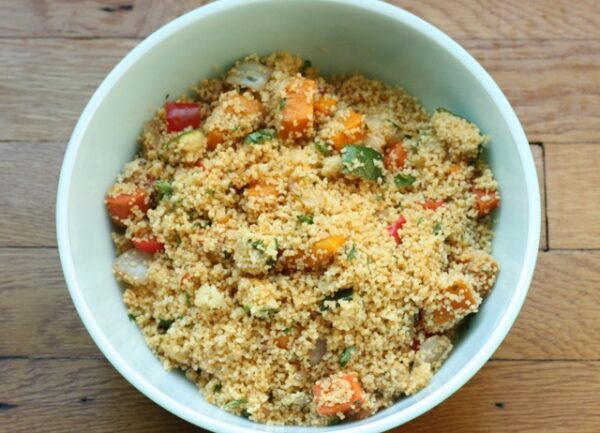
Tabbouleh salad with chicken.

Super fresh-tasting, almost summery, this salad of bulgur (more on that in a minute), bright parsley and mint, chopped vegetables and chicken is just the thing for lunch. Bulgur, a cracked and partially cooked wheat grain, is typically used in tabbouleh, the Middle Eastern mix with parsley and tomato that’s often served with pita bread. Here, it gets a bit more protein and some extra veggies. Bulgur is super-easy to prepare: Like couscous, it just gets covered with boiling water and left to soften. This lunchbox-friendly salad comes together in a snap, and it has about 150 calories per serving. Nice!

tabbouleh salad with chicken
(serves 4)

1/2 cup bulgur
1/2 cup boiling water
1 1/2 cups diced tomato
1 cup diced cooked chicken
3/4 cup minced fresh parsley
1/2 red bell pepper, in 1/4-inch dice
1/2 cucumber, peeled and seeded, in 1/4-inch dice
1 Tbsp. minced fresh mint
1 Tbsp. snipped fresh chives
juice of 1 lemon
1 Tbsp. good olive oil or lemon olive oil
1/2 tsp. coarse salt
1/4 tsp. freshly ground black pepper

In a small bowl, cover bulgur with 1/2 cup of boiling water; cover and let sit 15 minutes until water is absorbed and bulgur has a texture like al dente pasta. In a salad bowl, throw together all the ingredients and toss to coat with lemon juice and olive oil. Taste and adjust seasoning if needed. Serve at room temperature.

related recipes

a hearty vegetable salad with many variations
farro and roasted butternut squash
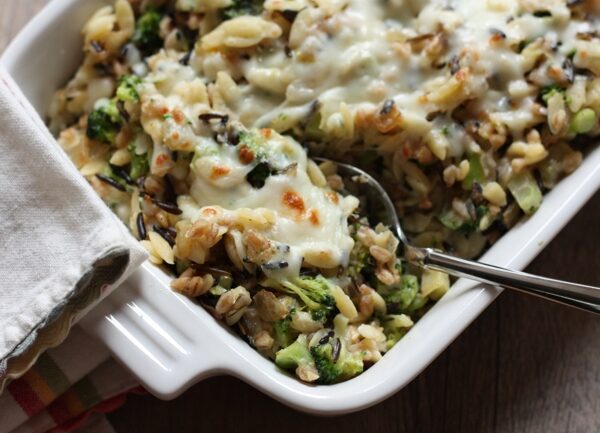
wild rice salad with chicken

Posted in Lunchbox, Recipes, Salads | Tagged , , , , | 1 Comment

An important local program is in danger.

Master Gardeners. 4-H. Those programs, and many other important services to the Cincinnati-area horticulture and farming industries—not to mention critical volunteer work that keeps our city beautiful and vibrant—are on the chopping block. Next week.

That’s because Hamilton County and the Metropolitan Sewer District are cutting off all funding for The Ohio State University’s Extension office in the county. For the first time since 1917, our area will be without this vital source of university-led research, education and information. Every dollar Hamilton County invests in OSU Extension returns $2.45 in services.

Last fall, after many years of wanting to do so, I enrolled in the Master Gardener program in Hamilton County. For those of you not familiar with Master Gardeners, these are folks who, after going through a thorough training program based on OSU’s horticultural research, volunteer throughout the community. Master Gardeners share their knowledge of plants, pests and practices through a local call-in garden helpline. We volunteer at Cincinnati parks, the zoo, Krohn Conservatory, Gorman Heritage Farm and other sites, lending labor and expertise to their planting and education programs.

More important, though OSU Extension programs support local farmers and growers by sharing the university’s latest research on growing practices, land and pest management, season extension, crop selection and more. And then there’s 4-H, which helps kids learn leadership as they take on projects involving raising animals, growing crops or creating crafts.

Lately, OSU Extension’s work in Hamilton County has involved working with the Metropolitan Sewer District on stormwater management initiatives—projects like planning, planting and maintaining massive rain gardens and landscapes around the county that mitigate rainwater runoff. MSD is under federal court order to get this problem under control, as the county’s insufficient sewer system allows waste- and stormwater to run into local creeks and rivers. (ICK!)

To my surprise, I haven’t seen this story reported in any local media. And, my Master Gardener experience notwithstanding, I’m dismayed to learn that local farmers and growers are losing access to this essential resource, and that our community is losing the coordinated efforts of horticultural volunteers who help keep our city beautiful.

So I’m publishing here to help spread the word. If you’re in the Cincinnati area and you’re also bugged by this, drop a note to our county commissioners, will you?

Posted in Eating local, Food 4 thought | Leave a comment

News you can use: foodie awards.

File under: Food news from our neck of the woods. The James Beard Foundation has announced the semifinalists for its influential annual awards program. A few notables from around these parts:

Best Chef: Great Lakes
Richard Blondin, Refectory Restaurant & Bistro, Columbus, OH
Jean-Robert de Cavel, Jean-Robert’s Table, Cincinnati
Greg Hardesty, Recess, Indianapolis
Anne Kearney, Rue Dumaine, Dayton
Regina Mehallick, R Bistro, Indianapolis
Kent Rigbsy, Rigsby’s Kitchen, Columbus, OH
Jonathon Sawyer,  The Greenhouse Tavern, Cleveland
David Tallent, Restaurant Tallent, Bloomington, IN

A bit farther afield: Harvest in Louisville, Salt in St. Louis, and Bistronomic and Next in Chicago are all nominees for Best New Restaurant; Tru in Chicago is among the contenders for Best Restaurant. The Aviary and The Violet Hour (Chicago) and The Old Fashioned (Madison, WI), got semifinalist nods for Outstanding Bar Program.

Funny: I didn’t see the Side Porch Café anywhere on the list …

Posted in Dinner, Food 4 thought | Tagged | Leave a comment

Buttery Special K cookies.

After yesterday’s heartfelt and rather serious post about making healthful choices about food, today’s post is all about butter. And cookies. [Whew!]

When Rob and I ventured to San Francisco and Sonoma County on our honeymoon more than two decades ago (I was a child bride), we stayed at a sweet little bed-and-breakfast in Pacific Grove, CA, called the Gosby House Inn. Our first afternoon, the innkeeper put out a plate of these cookies, and I’ve been baking them ever since.

special K cookies
(makes 30)

1 cup (2 sticks) unsalted butter, at room temperature
3/4 cup granulated sugar
1 tsp. vanilla extract
1 1/2 cups all-purpose flour
1 1/2 tsp. baking powder
pinch of salt
2 cups unsweetened cereal flakes (see Note)

Preheat oven to 350 degrees. In a large bowl, cream together butter and sugar until light and fluffy; add vanilla and blend to combine. In a separate bowl, whisk together flour, baking powder and salt; add to the butter mixture and blend well. Fold in cereal. Scoop out tablespoons of dough, form into rough balls and place on an ungreased cookie sheet about 2 inches apart. Bake for 12 to 15 minutes, until cookies are lightly brown around the edges. Let cool for a few minutes before transferring to a rack.

Note: While the original recipe calls for Special K (hence, the name), I’d suggest any unsweetened flake-type cereal: Kashi flakes, bran, wheat, rice or corn flakes.

Posted in Baking, Inspired by, Recipes | Tagged , , | Leave a comment

The power of our food choices.

Regardless of our politics, I think it’s safe to say that most of us feel completely disconnected, misrepresented and dismayed by government. It can make us feel powerless: After all, what individual can affect changes in the policies and systems that work against us? Big Money and Big Industry and Big Pharma and Big Ag shout louder and wield more influence and therefore shape the country and society and economy we all live in.

Over the weekend, though, I glanced a bit of hope, and it’s this: We CAN make a difference by the small choices we make, especially when it comes to food.

I attended the annual conference of the Ohio Ecological Food and Farming Association and, while I’m not a farmer or grower or producer, it was amazing to be in the company of those folks. I attended sessions about season extension, cover crops, companion planting, seasonal eating (other sessions dealt with topics like business planning and marketing for small farms, large-scale composting, raising livestock, fracking and Monsanto and GMOs). Over and over, I heard the mantra that the food community is at the heart of a movement (or revolution or whatever you want to call it) that can reshape our economy, our health, our industry, our environment, our communities and our relationships.

Now, before you think I’ve gone and drunk the Kool-aid, I’ll admit that I am already part of the choir to which the event was preaching. I’m not a farmer, but I know that my health and wellbeing depends on farmers doing their work with integrity and care. I love good, healthy, local food, and so I benefit from their labor.

The most important takeaway I gleaned (pun intended) from the conference was this from Andrew Kimbrell of the Center for Food Safety: We are not consumers. That which consumes, destroys. We are creators. And with every choice we make about our food, we can create one of two futures: 1) an industrialized, modified, commoditized, adulterated food system, or 2) a localized, holistic, humane, just, biodiverse food system. WE get to decide.

A few other nuggets I jotted in my notebook:

  • Because of poor soil stewardship, in 2008 alone, 2 million acres of Iowa farmland lost 20 or more tons (each!) of topsoil … it all washed down the Mississippi River, carrying with it chemical fertilizers, pesticides and herbicides. There’s a huge biological ‘dead zone’ at the Mississippi Delta. Think about this for a sec.
  • Collectively, we’ve invested more than $600 trillion (that’s a ‘T’) in the global derivatives market. The world’s GDP is $65 trillion. Do the math: There’s not enough money to cover those investments—and this complex financial system is incredibly opaque and off-the-radar. We’re making incredibly risky global investments … and yet, the farmer up the road can’t get a loan to buy fencing to house his livestock? WTF?
  • We need to break the physical and psychological disconnect between the industrial food system and our plates. Andrew Kimbrell noted that we’d make very different choices if we could see what goes into making this stuff.
  • Food is the most intimate relationship we have with our environment.

Wow. Heavy stuff, maybe too heavy for a Monday. [Sorry 'bout that.]

But here’s the thing: We have the power to improve our communities, our economy, our bodies, our planet. We do. We can shape our future simply through the foods we choose to eat ourselves and share with our families and neighbors.

Before you hit ‘unubscribe’ and never visit writes4food.com again because it’s justtoodamndepressing, take heart. My next post will be about cookies. Promise.

Posted in Eating local, Food 4 thought, Inspired by | Tagged , | 3 Comments

Sweet little blueberry trifles.

Weird, I know, but when I was sniffing around the interwebs looking for inspiration for a Valentine’s Day dessert, I wasn’t thinking chocolate. I wanted something a little different, something fruit-based. I spotted a photo of a pretty blueberry trifle in a glass jar, followed the link to My Baking Addiction and discovered a recipe that looked promising … but it was a little richer than I was in the mood for. Still, that photo inspired me to create a dessert with blueberries and, um, cake.

I’ll confess that I’m newly geeked about the ‘cute food in jars’ trend that’s been going on for awhile. [See Cheesecake in a Jar and Smores in a Jar.] This was my first dessert-in-a-jar attempt, and it made perfect use not only of the leftover quatre-quarts poundcake I made two weeks ago, but also of the recently acquired pair of 9-ounce Weck ‘Mold’ jars that I picked up at Crate & Barrel. [Yay!]

adapted from My Baking Addiction

individual blueberry trifles with whipped yogurt cream
(serves 2)

for the yogurt cream
1/3 cup heavy whipping cream
1/2 cup plain lowfat Greek yogurt
1 Tbsp. powdered sugar

In a chilled bowl, whip cream until soft peaks form. Add powdered sugar and whip to incorporate. Gently fold in Greek yogurt.

for the blueberry sauce (adapted from My Baking Addiction)
1 cup blueberries
1/4 cup sugar
1/4 cup water
1 Tbsp. fresh lemon juice
1 Tbsp. cornstarch mixed with 1 Tbsp. cold water
1/4 tsp. vanilla
zest of 1/2 lemon

Stir together blueberries, sugar, water and lemon juice in a small saucepan; bring to a low boil over medium heat. Stir in cornstarch/water mixture and cook, stirring, for about 5 minutes until the sauce thickens nicely. Remove from heat and stir in vanilla and lemon zest. Cool.

1 cup cubed poundcake (I used leftovers from Dorie Greenspan’s quatre-quarts recipe I made recently)

In jars or individual serving dishes or glass jars (I used Weck 9-ounce Mold jars), layer cubed poundcake, whipped yogurt cream and blueberry sauce; repeat, ending with blueberry sauce. Serve chilled.

Posted in Desserts, Recipes | Tagged , , | 1 Comment

Super-flavorful vegetable tart.

Full disclosure: When I made the vegetable tart featured in Bon Appétit’s January issue, my results weren’t nearly as photogenic as the gorgeous work of culinary artistry on the magazine’s cover. [But really, when does that ever happen?]

But oh my, was my vegetable tart incredibly delicious: full of savory vegetables, flecked with flavorful fresh thyme and enhanced with a generous hit of fresh goat cheese. You may think this resembles a quiche, but this tart recipe includes just 2 eggs and less than 1 cup of cream, so it’s less wicked than, say, your typical quiche Lorraine.

A few observations: This recipe is not difficult. It is, however, time-consuming. [And totally worth it!] Don’t do as I did an overlook the step of blind-baking the crust, which set me back a little time-wise. And be prepared for your blind-baked crust to shrink in the pie plate (that’s why my tart wasn’t as pretty as Bon Appétit’s).

This recipe was created by influential London chef and restaurateur Yottam Ottolenghi, whose inspiration shows up in the work of 101cookbooks.com founder Heidi Swanson, among others. Ottolenghi’s food tends toward the vegetarian, but it’s robust, complex, intriguing and full of flavor. I’ve adapted it by using my Grandma’s pie crust recipe and by making a few substitutions. (See the original vegetable tart recipe here.)

vegetable tart
(makes 6 servings)

For the tart crust (can be made 1 day ahead)
pastry for a single pie crust (Grandma’s foolproof flaky pie crust)

Preheat oven to 350 degrees. Roll the dough into a round about 13 inches in diameter and 1/8 inch thick; transfer to a pie plate and crimp edge. Freeze the crust for 15 minutes. Line the dough with a piece of foil that you’ve lightly sprayed with nonstick spray; fill with pie weights or dried beans and bake for 20 minutes. Remove foil and bake for another 20 minutes or until crust is very lightly golden.

For the filling (vegetables can be cooked 1 day ahead and refrigerated, separately)
1 red bell pepper (alternately, 1 jar of roasted bell peppers)
1 medium zucchini, cut into 1/2-inch dice
1 small sweet potato, peeled and cut into 1/2-inch dice
1 medium onion, quartered top-to-bottom and thinly sliced
1 medium fennel bulb, quartered top-to-bottom and thinly sliced
1/3 cup sun-dried tomatoes packed in oil, drained and rinsed (I used oven-dried tomatoes from my freezer)
2 tsp. fresh thyme leaves
4 oz. fresh goat cheese, crumbled
2 eggs
3/4 cup heavy cream
3 Tbsp. olive oil
salt and pepper

Roast the bell pepper: Preheat broiler. Trim stem from pepper, slice in half lengthwise and remove seeds. Place pepper halves on a foil-lined baking sheet; press to flatten with your hand. Broil until skin is charred black all over, about 10 minutes. Transfer pepper to a bowl; cover with foil to steam the skin loose. Remove skin and tear pepper into wide strips.

Roast the squash and sweet potato: Preheat oven to 450 degrees; line a rimmed baking sheet with foil. Toss potato and zucchini cubes with 1 Tbsp. olive oil; season well with salt and pepper. Spread on foil-lined baking sheet and roast for 20 minutes, until vegetables are lightly browned and tender but not mushy.

Prepare the fennel and onion: In a large skillet, warm 2 Tbsp. olive oil over medium-high heat until it shimmers. Add fennel and onion slices; reduce heat slightly and cook, stirring occasionally, until vegetables are translucent and still crisp-tender, about 7 minutes. Season well with salt and pepper.

Assemble the tart: Preheat oven to 350 degrees. Whisk eggs and cream together in a bowl; season with pepper. Distribute onion/fennel mixture in the bottom of the tart shell. Top with zucchini/sweet potato mixture, then roasted red peppers, then 1 tsp. of fresh thyme. Top with crumbled goat cheese, then with sundried tomatoes. Carefully pour egg/cream mixture over the top, then sprinkle with remaining fresh thyme. Bake for 45–50 minutes, until filling is set. (Note: If you find the crust is browning too quickly, then take a square of foil and cut out a circle, about 6 inches in diameter, from the middle. Place foil over the pie to cover the crust.) Serve warm or at room temperature.

Posted in Dinner, Recipes, Vegetarian | Tagged , , , , | Leave a comment